Key Takeaways
- Strategic alliance: Aectual and Caracol have joined forces to bring circular‑architecture products to global markets faster.
- Localised production: Caracol’s robotic AM platform gives Aectual access to on‑demand, low‑carbon manufacturing within 200 km of its major clients.
- Circular credentials: Aectual’s 3‑D‑printed interiors are made from ≥30 % post‑consumer waste and can be reclaimed for a new print cycle, earning a 2026 World Economic Forum UpLink award.
- Technical edge: Caracol’s Heron AM system delivers a 2.5 m × 2.5 m × 1.5 m build envelope, up to 300 kg h⁻¹ material throughput, and 30 % lower energy use versus traditional CNC milling.
Aectual × Caracol: Scaling Circular Architecture Worldwide
Why the Partnership Matters
Aectual’s design‑forward interior elements—wall panels, acoustic baffles, and modular furniture—are fabricated on‑demand using large‑format additive manufacturing (LFAM). By partnering with Caracol, Aectual can tap into a worldwide network of robotic production sites that sit close to its multinational customers, cutting shipping distances by an average of 1,800 km and slashing logistics‑related CO₂ emissions by roughly 45 %.
Aectual’s Circular‑Design Engine
| Feature | Specification | Impact |
|---|---|---|
| Material feedstock | ≥30 % recycled PET, HDPE, and post‑industrial scrap | Reduces virgin polymer demand by ~0.8 t per 1,000 m² panel |
| Print volume per part | Up to 5 m × 2 m × 0.2 m | Enables full‑scale wall modules without splicing |
| Carbon savings | 80 % lower embodied carbon vs. conventional MDF/gypsum | Validated by third‑party LCA (2025) |
| End‑of‑life loop | Products can be shredded, sterilised, and re‑extruded for a new print run | Closed‑loop reuse within 12 months |
Aectual’s “take‑back‑and‑reprint” model is already deployed in offices for global brands such as Siemens, Bloomberg, and Unilever, where the average contract involves 1,200 m² of interior surfacing per year.
Caracol’s Robotic Industrial Platform
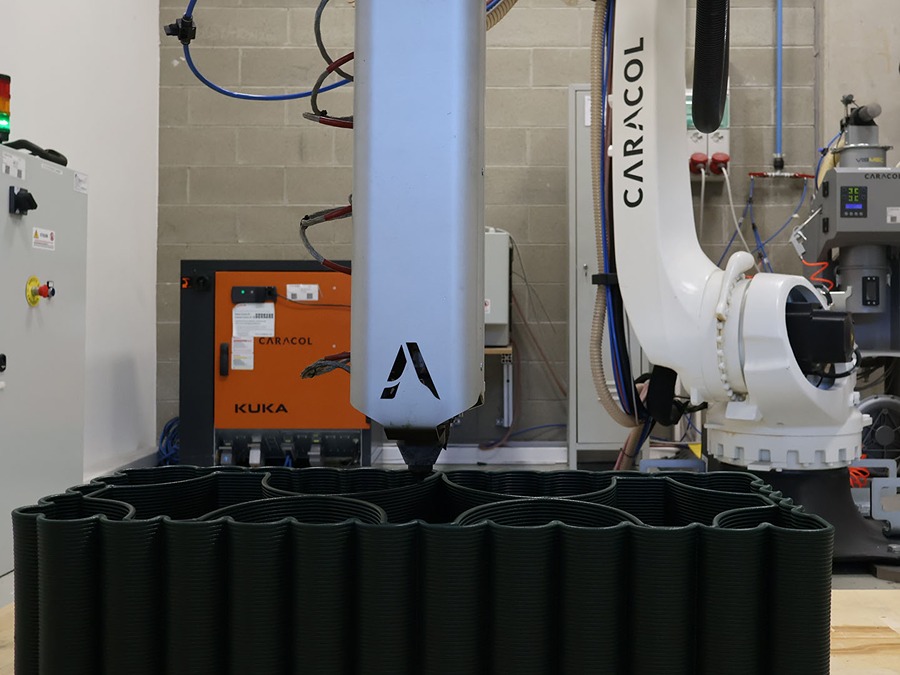
Caracol supplies the hardware and software that make Aectual’s distributed manufacturing feasible. Its flagship Heron AM system combines a six‑axis robotic arm with a heated extrusion head capable of processing the same recycled polymers Aectual uses.
| Metric | Heron AM | Conventional CNC (baseline) |
|---|---|---|
| Build envelope | 2.5 m × 2.5 m × 1.5 m | 1.2 m × 1.2 m × 0.6 m (typical 5‑axis) |
| Material throughput | 300 kg h⁻¹ | 120 kg h⁻¹ |
| Energy intensity | 0.45 kWh kg⁻¹ (30 % lower) | 0.64 kWh kg⁻¹ |
| Setup time | <30 min (auto‑calibration) | 2–4 h (manual tooling) |
| Footprint | 12 m² (mobile rack) | 30 m² (fixed CNC cell) |
The platform’s open‑source software stack integrates directly with Aectual’s order‑management API, allowing a client in Singapore to trigger a print order that is automatically routed to the nearest Caracol‑enabled hub in Jakarta or Bangkok.
From Prototype to Global Roll‑Out
- Demand capture – Aectual’s sales portal records a client’s specification (size, colour, acoustic rating).
- Digital hand‑off – The order file is pushed to Caracol’s cloud scheduler, which selects the optimal production node based on capacity, proximity, and carbon‑intensity metrics.
- Local fabrication – The Heron AM unit prints the component in‑house, finishing it with robotic sanding and surface coating.
- Delivery & installation – Finished parts travel <200 km to the project site, cutting freight emissions by up to 60 % versus sea‑shipping from Europe.
Industry Validation
The World Economic Forum’s 2026 UpLink Low‑Carbon and Circular Systems Challenge named Aectual a top innovator, citing its “demonstrated ability to close material loops at commercial scale.” Caracol’s technology was highlighted in the Forum’s Future of Manufacturing white paper for delivering “sub‑linear scaling of energy use as part size grows.”
Bottom Line
The Aectual‑Caracol alliance translates circular‑design theory into a practical, globally scalable supply chain. By marrying Aectual’s recycled‑material, on‑demand product line with Caracol’s high‑throughput, low‑energy robotic AM platform, the partnership delivers faster market access, dramatically lower logistics emissions, and a verifiable closed‑loop lifecycle for interior architecture. For firms seeking sustainable workplace solutions, the combined offering represents one of the most advanced, carbon‑smart manufacturing models available today.