Key Takeaways
- Thermoplastics have limitations in additive manufacturing (AM) for demanding applications
- Thermosets offer improved thermal resistance and durability, but are challenging to integrate into large-scale AM systems
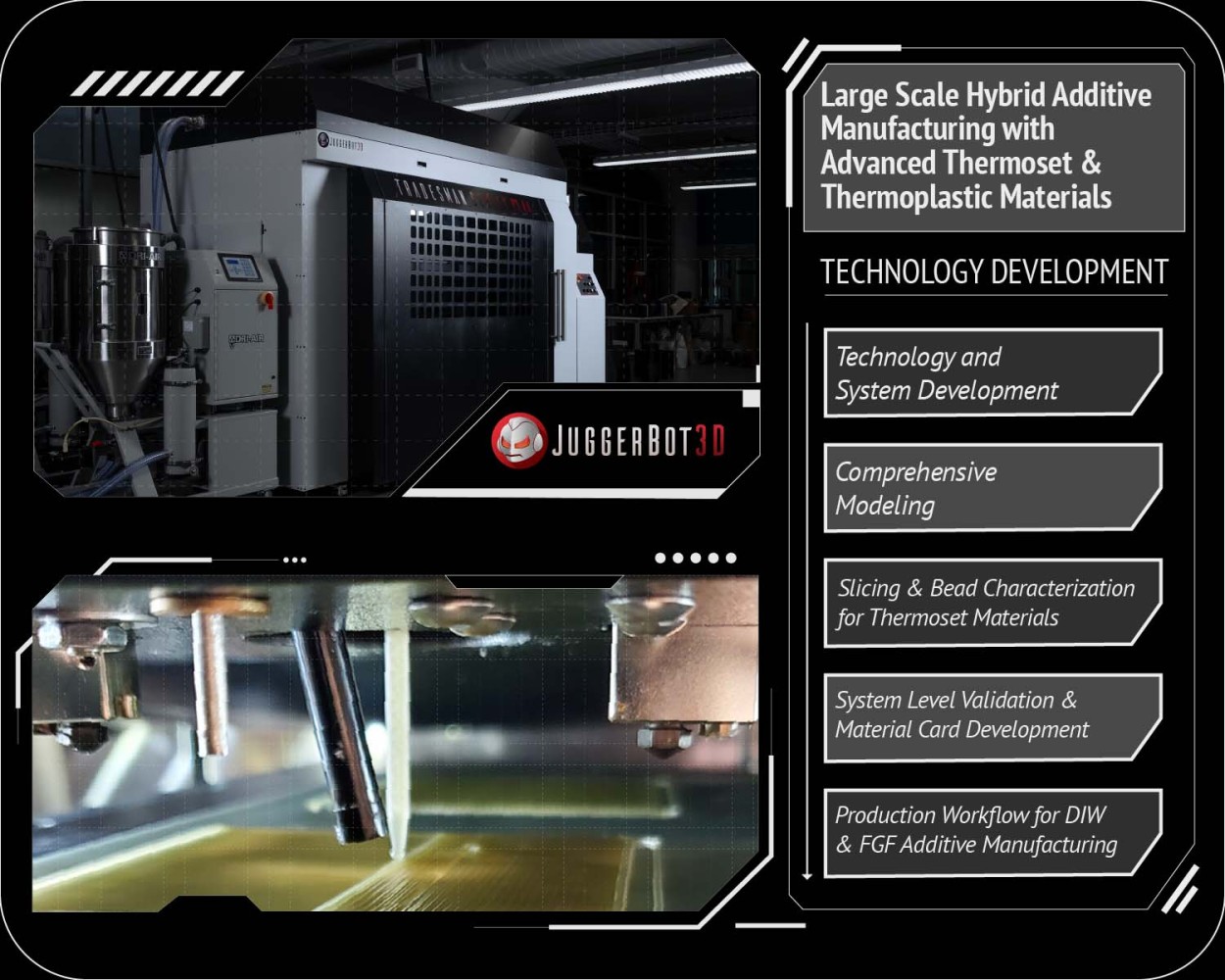
- JuggerBot 3D has developed a hybrid system, the H6-106, that combines thermoplastic and thermoset processing
- The H6-106 system is designed for industrial applications and has been developed through a multi-year research effort
- The system has been funded by the Office of the Under Secretary of Defense for Research and Engineering and managed through the Air Force Research Laboratory (AFRL)
Introduction to Hybrid AM
Additive manufacturing (AM) has long relied on thermoplastics as the primary material for production. However, as the industry expands to more demanding applications, the limitations of thermoplastics are becoming increasingly apparent. Thermosets, a type of material commonly used in traditional manufacturing, are being explored as a potential solution.
Thermosets vs Thermoplastics
Thermosets and thermoplastics have distinct properties that make them suitable for different applications. Thermoplastics are easy to process and can be melted and reshaped multiple times, making them ideal for prototyping and production tooling. In contrast, thermosets are designed to hold their shape once cured and cannot be melted down and reshaped. This property makes them useful for applications where parts need to withstand high temperatures and heavy use over long periods.
Comparison of Thermosets and Thermoplastics
| Material | Properties | Applications |
|---|---|---|
| Thermoplastics | Easy to process, can be melted and reshaped | Prototyping, production tooling |
| Thermosets | Holds shape once cured, withstands high temperatures | Aerospace, defense, automotive |
JuggerBot 3D's Hybrid System
JuggerBot 3D, an Ohio-based company, has developed a hybrid system that combines thermoplastic and thermoset processing. The H6-106 system is designed for industrial applications and has been developed through a multi-year research effort. The system has been funded by the Office of the Under Secretary of Defense for Research and Engineering and managed through the Air Force Research Laboratory (AFRL).
Specifications of the H6-106 System
The H6-106 system has the following specifications:
- Build volume: 6 feet x 6 feet x 10 feet
- Material compatibility: Thermoplastics and thermosets
- Printing speed: Up to 100 mm/s
- Layer resolution: Up to 100 microns
Bottom Line
The development of hybrid additive manufacturing systems, such as the H6-106, marks a significant step forward in the industry. By combining the benefits of thermoplastics and thermosets, manufacturers can produce parts with improved thermal resistance and durability, making them suitable for demanding applications in aerospace, defense, and automotive. With its large-format capabilities and advanced material processing, the H6-106 system is poised to play a key role in the future of additive manufacturing.