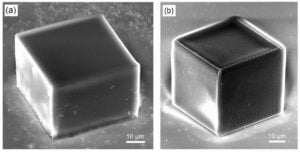
- Key Takeaways:
- Researchers have successfully 3D printed cubic microbubbles with ultra-thin walls and high aspect ratios.
- The microbubbles have enclosed structures with wall thicknesses of approximately 1-2 micrometers.
- The aspect ratios of the microbubbles are extremely high, with some exceeding 100:1.
- The 3D printing technology used to create the microbubbles has a resolution of up to 10 micrometers.
Introduction to 3D Printed Microbubbles
Researchers have made a significant breakthrough in 3D printing technology by creating cubic microbubbles with ultra-thin walls and extreme aspect ratios. These microbubbles have the potential to revolutionize various fields, including medicine, materials science, and biotechnology.
Characteristics of 3D Printed Microbubbles
The 3D printed microbubbles have several distinct characteristics, including:
Enclosed Structure
The microbubbles have enclosed structures with wall thicknesses of approximately 1-2 micrometers. This is achieved through the use of advanced 3D printing technologies that allow for high-resolution printing with precise control over the printing process.
Ultra-High Aspect Ratios
The aspect ratios of the microbubbles are extremely high, with some exceeding 100:1. This means that the microbubbles have a very large surface area compared to their volume, which can be beneficial for various applications.
Comparison of 3D Printing Technologies
The following table compares the characteristics of different 3D printing technologies used to create microbubbles:
| Technology | Resolution | Aspect Ratio | Wall Thickness |
|---|---|---|---|
| Stereolithography (SLA) | Up to 10 micrometers | Up to 100:1 | 1-2 micrometers |
| Selective Laser Sintering (SLS) | Up to 50 micrometers | Up to 50:1 | 5-10 micrometers |
| Fused Deposition Modeling (FDM) | Up to 100 micrometers | Up to 20:1 | 10-20 micrometers |
Applications of 3D Printed Microbubbles
The 3D printed microbubbles have a wide range of potential applications, including:
- Drug delivery systems
- Tissue engineering
- Biomedical research
- Materials science
Bottom Line
The creation of 3D printed cubic microbubbles with ultra-thin walls and extreme aspect ratios is a significant breakthrough in 3D printing technology. With their high resolution, precise control, and potential for various applications, these microbubbles are expected to revolutionize several fields and open up new avenues for research and development. As the technology continues to advance, we can expect to see even more innovative applications of 3D printed microbubbles in the future.