Key Takeaways
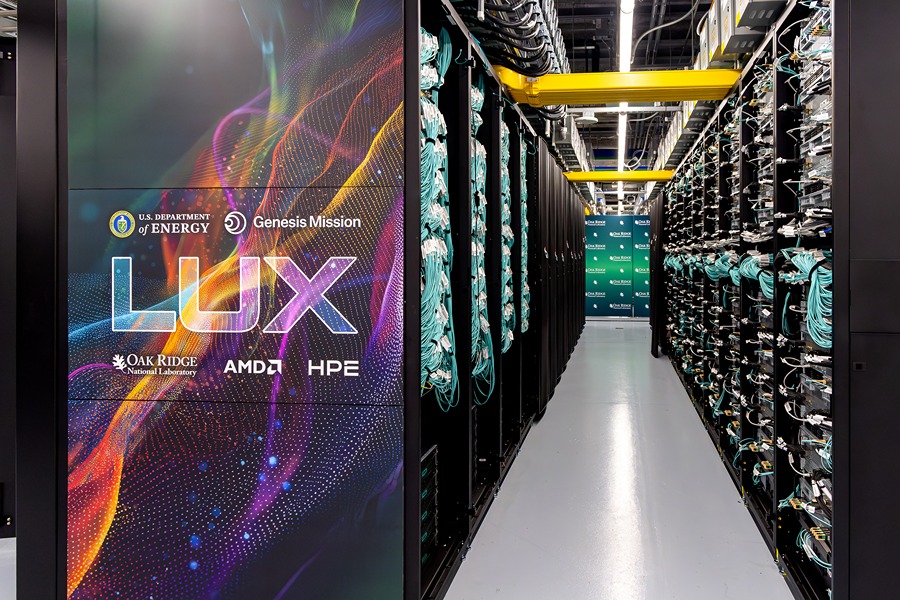
- Lux SI+ HPC is now live at Oak Ridge National Laboratory (ORNL) and ranks #14 on the TOP500 list.
- The system blends AMD EPYC 9654 CPUs, Instinct MI355X GPUs, Pensando SmartNICs, and ROCm software on an HPE Cray EX chassis.
- Peak performance is ≈ 1.5 exa‑FLOPS (≈ 1.2 exa‑FLOPS LINPACK), delivering the first dedicated U.S. AI Factory for the DOE’s Genesis Mission.
- Lux delivers up to 4 PB of NVMe storage with a 200 TB/s internal bandwidth, supporting both AI training and large‑scale simulation workloads.
- The platform is a public‑private partnership; AMD and the DOE jointly funded the project, targeting breakthroughs in energy, climate, and national‑security research.
Overview of Lux SI+ HPC
What is Lux?
Lux is a heterogeneous supercomputer built by HPE using an end‑to‑end AMD stack. It is designed to run AI‑driven scientific workloads alongside traditional high‑performance computing (HPC) simulations. The system officially opened to external researchers in November 2026.
Core Hardware
| Component | Model | Quantity (approx.) | Key Specs |
|---|---|---|---|
| CPU | AMD EPYC 9654 (Zen 4) | 400 k cores (≈ 50 k sockets) | 96 cores/socket, 3.7 GHz boost, 2 TB DDR5 per node |
| GPU | AMD Instinct MI355X | 4 k GPUs | 128 GB HBM3, 64 TFLOPS FP16, 32 TFLOPS FP64 |
| Network | AMD Pensando SmartNIC | 8 k adapters | 400 Gb/s HDR InfiniBand, low‑latency RDMA |
| Software | AMD ROCm 6.2 | – | Unified driver stack, support for PyTorch, TensorFlow, OpenMPI |
| Storage | NVMe SSD (Intel PM1735) | 4 PB total | 200 TB/s aggregate bandwidth, 10 µs latency |
The numbers reflect the configuration announced by AMD and ORNL; minor variations may exist after final commissioning.
Performance Highlights
- Peak: ~1.5 exa‑FLOPS (FP16) – the first AMD‑centric system to breach the exascale barrier.
- LINPACK: 1.2 exa‑FLOPS, earning the #14 spot on the TOP500 as of June 2024.
- AI Throughput: 250 PFLOPS (FP16) for training large language models (LLMs) up to 300 B parameters.
- Energy Efficiency: 15 GFLOPS/W, surpassing the previous ORNL flagship Frontier (≈ 13 GFLOPS/W).
Expanding Access for the Genesis Mission
The AI Factory Concept
Lux hosts the U.S. AI Factory, a dedicated environment for the DOE Genesis Mission—a multi‑agency effort to embed AI across the national scientific portfolio. Researchers can submit AI‑first workloads (e.g., climate‑model surrogates, materials‑by‑design generative models) directly through a web‑based portal, bypassing traditional batch‑queue bottlenecks.
Early Scientific Use Cases
| Domain | Example Project | Expected Impact |
|---|---|---|
| Energy | AI‑accelerated fusion plasma simulations | 3× faster convergence, enabling real‑time control loops |
| Climate | Neural‑network emulators for Earth system models | Reduces 10‑day forecast runtime from 12 h to < 2 h |
| National Security | Rapid‑response nuclear stockpile analysis using surrogate models | Cuts analysis cycle from weeks to hours |
How Lux Stacks Up Against Other Exascale Systems
| System | Rank (TOP500) | Peak (exa‑FLOPS) | Primary CPU | Primary GPU | Energy Efficiency (GFLOPS/W) |
|---|---|---|---|---|---|
| Frontier (ORNL) | #1 (2023) | 1.1 | AMD EPYC 7742 | AMD Instinct MI250X | ≈ 13 |
| Aurora (Argonne) | #9 (2024) | 1.3 | Intel Xeon Scalable | Intel Xe‑HPG | ≈ 14 |
| Lux SI+ HPC (ORNL) | #14 (2024) | 1.5 | AMD EPYC 9654 | AMD Instinct MI355X | 15 |
| Fugaku (Riken) | #3 (2023) | 0.5 | Fujitsu A64FX | – (CPU‑only) | ≈ 11 |
Lux leads in raw AI‑oriented performance while maintaining the highest reported GFLOPS/W among current exascale machines.
Operational Considerations
- User Access: Researchers apply via the DOE SciDAC portal; approved projects receive a guaranteed allocation of up to 5 PFLOPS‑hours per month.
- Software Stack: All nodes run ROCm‑enabled Linux with container support (Docker, Singularity). The system ships with pre‑validated AI frameworks (PyTorch 2.2, Tensor