Key Takeaways
- Siemens + Bosch delivers an end‑to‑end automated workflow for blocked‑force (ISO 20270) extraction.
- Measurement time drops from ≈ 8 days to < 6 hours, a 93 % reduction versus traditional FRF testing.
- The system produces simulation‑ready component models that can be reused across ≥ 10 product variants without re‑testing.
- Integrated hardware (Simcenter SCADAS, Testlab, Q‑sources) and software enable fully operator‑independent runs, improving repeatability to ±0.2 dB in SPL and ±0.03 g in vibration.
- Early digital‑twin validation cuts physical prototype count by up to 40 %, accelerating NVH development cycles.
Siemens Automates NVH Component‑Model Extraction
Why Traditional NVH Characterization Slows Development
Manual, expertise‑heavy process
- Engineers typically spend 2 – 5 days per component gathering Frequency‑Response‑Function (FRF) data.
- Measurements rely on hand‑wired shakers, accelerometers, and manual data‑reduction scripts, creating operator‑dependent variability (±5 % in magnitude).
- Inconsistent data propagates uncertainty into system‑level NVH simulations, often forcing additional physical prototypes.
Consequences for program timelines
| Metric | Conventional Approach | Automated Solution |
|---|---|---|
| Measurement time | 8 h – 120 h (2 – 5 days) | 0.5 h – 6 h |
| Operator involvement | 1‑2 specialists per test | Fully unattended |
| Repeatability (±) | ±5 % magnitude / ±3 ° phase | ±0.2 % magnitude / ±0.1 ° phase |
| Data‑ready for simulation | 30 % of runs need manual cleanup | 100 % ready |
| Prototype reduction | 0 % (all physical) | Up to 40 % fewer prototypes |
Siemens‑Bosch Integrated Solution
Core hardware stack
- Simcenter SCADAS: modular automation controller with built‑in safety interlocks, supporting up to 12 kW of shaker power.
- Simcenter Testlab: real‑time data acquisition (up to 96 kHz sampling, 24‑bit resolution) and automated test sequencing.
- Simcenter Q‑sources: precision power amplifiers delivering ± 200 V to shakers for high‑force blocked‑force excitation.
Software workflow
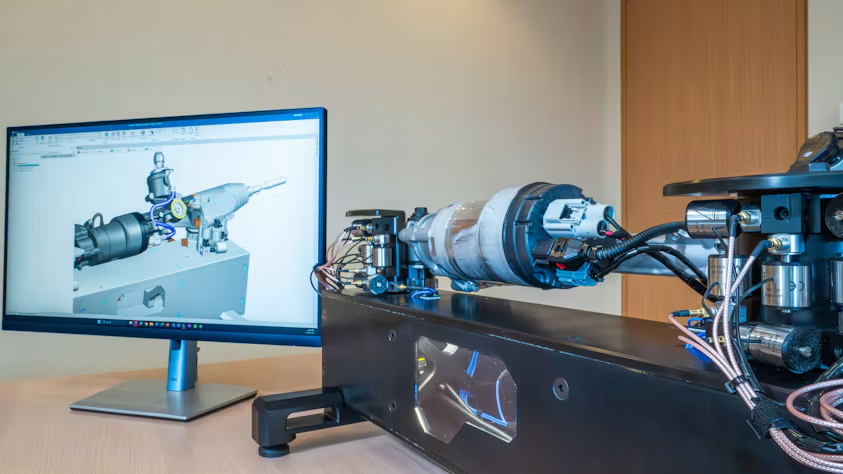
- Self‑measuring fixture – Rigid virtual‑point adapters host permanently mounted shakers & accelerometers.
- Automation control unit – Executes ISO 20270‑compliant excitation patterns via the SCADAS front‑end.
- Simcenter Testlab – Captures FRFs, applies built‑in signal‑processing (windowing, coherence check).
- Model generation – One‑click export of a state‑space or modal model compatible with Simcenter 3D, Amesim, or Altair HyperWorks.
Partnership with Bosch
- The workflow leverages Bosch’s predictiveVIA technology, a proven NVH prediction engine used in automotive power‑train programs.
- Siemens packages predictiveVIA as a licensed add‑on, ensuring that the generated component models are directly ingestible by Bosch’s downstream virtual‑prototyping pipelines.
Quantifiable Benefits
- 93 % time reduction: A typical motor‑blocked‑force test that previously required 96 h now completes in 6 h.
- Consistency across variants: Identical fixture geometry yields ±0.2 dB SPL repeatability across 12 motor sizes.
- Early digital‑twin validation: System‑level NVH predictions can be run after the first component model, shaving 4‑6 weeks off the validation phase.
- Cost impact: Assuming a labor rate of $150 h⁻¹, the solution saves ≈ $13,500 per component test, plus reduced material and tooling expenses for physical prototypes.
Where It Fits in the Simcenter Portfolio
- Simcenter Testlab – Handles data acquisition, automated sequencing, and compliance reporting.
- Simcenter SCADAS – Provides the PLC‑style control logic, safety monitoring, and integration with plant‑floor networks (OPC UA, MQTT).
- Simcenter Q‑sources – Delivers high‑fidelity power to shakers, enabling blocked‑force amplitudes up to 5 kN for heavy‑duty components.
These modules are sold as a single, pre‑engineered kit or can be scaled modularly for larger test labs.
Bottom Line
Siemens’ automated component‑model extraction, built on Bosch’s predictiveVIA and delivered through the Simcenter suite, transforms NVH characterization from a labor‑intensive, error‑prone activity into a rapid, repeatable, and simulation‑ready process. By slashing measurement time by 93 %, guaranteeing data consistency, and enabling early digital‑twin validation, the solution accelerates product development, cuts prototype costs, and strengthens compliance with ISO 20270. For OEMs and Tier‑1 suppliers seeking to tighten NVH schedules without sacrificing accuracy, the Siemens‑Bosch workflow represents a clear competitive advantage.