Key Takeaways
- Application insight must go beyond part geometry; it starts with the customer’s revenue model.
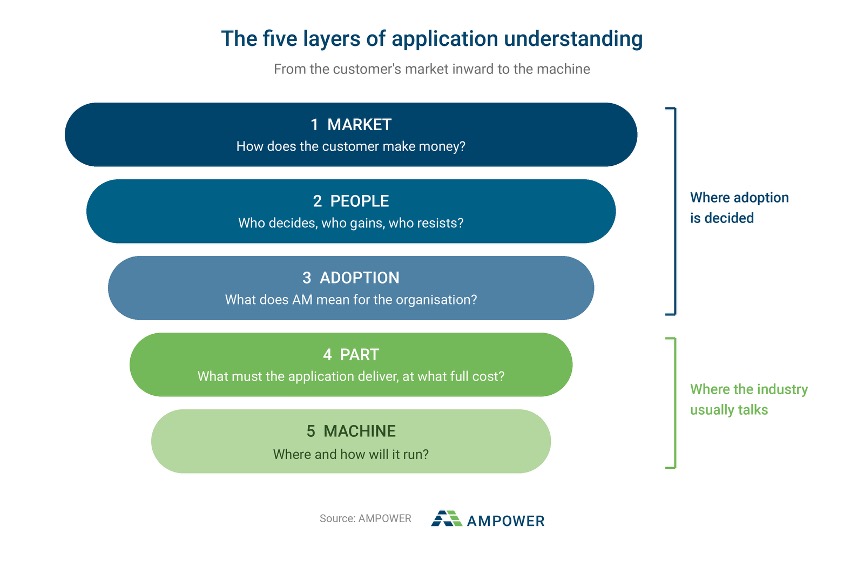
- Five “layers”—Market, Business, Process, Part, Machine—form a hierarchy that guides AM sales conversations.
- Orthopaedic, dental, and defence sectors illustrate how the same metal-laser system is positioned differently at each layer.
- Suppliers that only speak the language of tolerances miss the strategic levers that drive purchase decisions.
- Mapping the five layers to a concrete value-chain helps AM vendors quantify ROI and reduce sales cycle time.
Understanding Application Depth: From Market to Machine
Layer 1 – Market: Where Does the Customer Capture Value?
The first question a supplier must answer is how the end-user earns money.
- Orthopaedics: Implant makers typically enjoy 30-45 % gross margin on mature product lines, but face €2–5 M in regulatory and clinical-trial spend per new design.
- Dental labs: Margins hover around 15-25 %, with a $200 k–$500 k capital outlay for intra-oral scanners and milling units.
- Defence procurement: Margins are often lower (10-20 %) because contracts are price-fixed, yet the total lifecycle cost can exceed $50 M for a single platform.
If an AM solution cannot improve the profit levers identified at this level—whether by lowering development cost, shortening time-to-market, or enabling a premium-priced product—its technical merits will never translate into a sale.
Layer 2 – Business Model: Who Pays and Who Bears Risk?
Understanding who absorbs cost and who reaps revenue clarifies the risk-reward balance.
| Sector | Primary Payer | Risk Owner | Typical ROI Horizon |
|---|---|---|---|
| Orthopaedic implants | Hospital / insurer | Manufacturer (regulatory) | 2–3 years |
| Dental labs | Patient (out-of-pocket) | Lab owner (equipment) | 12–18 months |
| Defence systems | Government contract | Prime contractor | 3–5 years |
A supplier that tailors its value proposition to the correct stakeholder—e.g., emphasizing regulatory-ready material certifications for orthopaedics, rapid design iteration for dental labs, or low-observable alloy performance for defence—will align with the buyer’s risk appetite.
Layer 3 – Process: How Is the Part Made Today?
Current manufacturing pathways dictate the baseline cost and lead-time that AM must beat.
- Orthopaedic: CNC-machined Ti-6Al-4V blanks cost ≈ €120 / unit with a 4-week tooling lead time.
- Dental: Subtractive milling of zirconia incurs ≈ $15 / crown and a 48-hour turnaround.
- Defence: Traditional investment casting of Inconel-718 can exceed $3 k / component and require 8-12 weeks for pattern production.
If laser-based powder bed fusion (LPBF) can deliver comparable tolerances (± 0.05 mm) at ≤ 70 % of the current cost and ≤ 30 % of the lead time, the business case becomes compelling.
Layer 4 – Part: Geometry, Material, and Performance Specs
At this stage the conversation turns technical. Suppliers must map machine capabilities to part requirements:
- Feature size: Minimum wall thickness of 0.3 mm for lattice-structured hip stems.
- Surface roughness: Ra ≤ 1.6 µm post-polish for dental crowns.
- Mechanical properties: Yield strength ≥ 950 MPa for defence brackets.
Only when the AM system’s laser power (400 W), layer thickness (20–30 µm), and build envelope (250 × 250 × 300 mm) meet or exceed these thresholds can the supplier claim technical parity.
Layer 5 – Machine: Shop-Floor Reality
The final layer concerns availability, reliability, and cost of ownership.
- Capital expense: A production-grade LPBF unit (e.g., EOS M 400) lists at ≈ €750 k.
- Uptime: Industry benchmarks target ≥ 85 % annual availability.
- Material consumption: Powder reuse cycles of 10 + runs reduce material cost by ≈ 30 %.
A transparent total-cost-of-ownership (TCO) model that incorporates energy use (≈ 1.2 kWh / cm³), maintenance contracts, and training is essential to close the sale.
Putting the Layers Together – A Practical Example
Consider a mid-size orthopaedic firm launching a next-generation hip stem:
- Market – 40 % margin on existing line, seeks to capture a €10 M niche market.
- Business – Development budget capped at €4 M, regulator (FDA/EMA) holds approval risk.
- Process – Current CNC route costs €150 / stem, 5-week lead time.
- Part – Requires 0.3 mm lattice, Ti-6Al-4V, surface Ra ≤ 1 µm.
- Machine – Needs a printer capable of ≥ 250 mm build height, 85 % uptime.
An AM vendor that can demonstrate a 30 % cost reduction, 50 % lead-time cut, and a validated material traceability package directly addresses each layer, turning a technical pitch into a business win.
Bottom Line
Successful additive-manufacturing sales hinge on a five-layer framework that moves from the customer’s revenue engine down to the shop-floor equipment. By quantifying market margins, risk allocation, existing process costs, part specifications, and machine economics, AM suppliers can craft proposals that speak the language of profit, not just precision. In a competitive landscape, the ability to map every technical advantage to a concrete financial benefit is the decisive edge.


