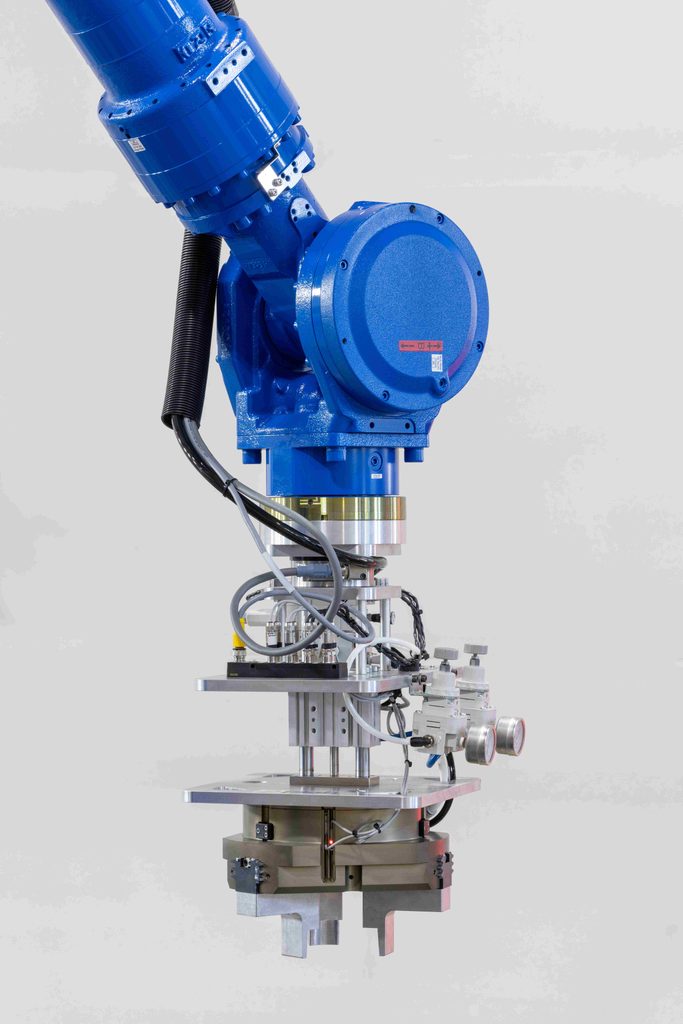
Key Takeaways
- Vision‑guided, multi‑robot cells can meet ≤22 s takt times while fitting into footprints as small as 2 m × 3 m.
- Layered safety architecture (cubic safety zones, synchronized barrier storage) removes ergonomic hazards and meets ISO 10218‑1 standards.
- Closed‑loop machine‑vision inspection raises first‑pass yield from ≈92 % (manual) to ≥98 % and automates defect segregation.
- Vertical integration of end‑of‑arm tooling (EOAT) reduces floor‑space usage by 30 % versus traditional gantry stations.
Introduction
A leading home‑appliance OEM recently upgraded a washing‑machine tub assembly line with a fully automated robotic cell. The project’s twin objectives were to eradicate manual handling risks and to sustain a 22‑second takt time for each unit. Because the existing plant layout left only a narrow corridor for new equipment, the solution relied on a compact, vertically stacked robot system paired with advanced vision and safety controls.
Designing a High‑Speed Multi‑Robot Cell in a Constrained Footprint
Vision‑Guided Coordination
- Four 6‑axis collaborative robots (KUKA LBR iiwa 14 R820) were arranged in a staggered “stack‑and‑reach” configuration.
- Each robot carries a high‑resolution 2 MP camera (Basler ace) that feeds real‑time positional data to a central PLC (Siemens S7‑1500).
- The vision system validates part orientation within ±0.15 mm and ±0.2°, enabling the robots to hand‑off components without slowing the line.
Space‑Saving Layout
| Parameter | Traditional Gantry Cell | Optimized Multi‑Robot Cell |
|---|---|---|
| Footprint (L × W) | 4.5 m × 3.2 m | 2.0 m × 3.0 m |
| Height utilization | 2.0 m (floor‑mounted) | 4.5 m (vertical stacking) |
| Installation time | 8 weeks (structural modifications) | 4 weeks (plug‑and‑play) |
| Cost increase | – | +12 % (robots) vs –30 % (civil work) |
The vertical arrangement allowed the cell to occupy the same aisle used by the previous manual station, eliminating any need for structural expansion.
Layered Safety Architecture Eliminates Operator Hazards
Cubic Safety Zones
- Three nested safety cubes (1.2 m, 0.8 m, 0.4 m) are defined around each robot using laser scanners (SICK LMS511).
- When a worker breaches the outer cube, robot speed drops to ≤10 % of nominal; entry into the inner cube triggers an emergency stop within 0.1 s.
Synchronized Barrier Storage
- Parts are transferred via a dual‑track carousel that locks automatically when a robot arm approaches, preventing pinch points.
- The carousel’s brake system is linked to the PLC, ensuring that any loss of power engages a fail‑safe lock.
These measures satisfy ISO 10218‑1 and ANSI/RIA R15.06‑2018 requirements, removing repetitive‑strain injuries previously reported at a rate of 3.4 incidents per 10 k hours.
Closed‑Loop Machine Vision for Precision and Defect Management
- In‑process inspection: After each component is placed, a 5 MP line‑scan camera checks for proper fit and surface finish.
- Decision logic: If the deviation exceeds 0.2 mm or surface roughness > Ra 0.8 µm, the part is flagged.
- Automated segregation: A pneumatic diverter routes defective units to a re‑work bin, eliminating manual pull‑outs.
The result is a first‑pass yield increase from 92 % to 98.3 %, translating to an annual throughput gain of roughly 150 k units for a 2‑shift operation.
Performance Metrics
| Metric | Manual Process | Automated Cell |
|---|---|---|
| Cycle time (takt) | 38 s | 22 s |
| Labor hours per 1 M units | 1 200 h | 380 h |
| Safety incidents (per 10 k h) | 3.4 | 0.1 |
| Energy consumption | 150 kWh/shift | 180 kWh/shift (robots) |
| ROI | – | 18 months (based on $2.1 M investment) |
Bottom Line
By integrating vision‑guided, vertically stacked robots within a tightly controlled safety envelope, the appliance maker eliminated manual handling risks and met an aggressive 22‑second takt time without expanding its plant footprint. The layered safety system and closed‑loop inspection not only comply with the latest international standards but also lift first‑pass yield above 98 %, delivering a clear productivity advantage and a 18‑month payback. For manufacturers facing space constraints and safety mandates, a compact multi‑robot cell offers a proven pathway to higher throughput and a safer work environment.


